Ricon Tools Ricon Tools

How to Find Maximum Speed for a 4 Jaw Woodworking Chuck?

Time:2026-10-18 Author:Isabella
0%

Finding the safe operating speed of a four-jaw woodworking chuck requires more than reading one number. Woodworkers often ask, “what is the maximum speed for a 4 jaw woodworking chuck,” but the answer depends on the chuck’s design, diameter, jaw condition, and manufacturer rating. A small, well-balanced chuck may tolerate higher speeds than a large chuck holding an uneven bowl. The lathe’s speed range matters too. So does the wood.

This guide explains how to estimate maximum speed responsibly. It considers published specifications, chuck balance, jaw engagement, workpiece shape, and spindle vibration. A dry, balanced blank usually behaves differently from a cracked branch or irregular green wood. Check the chuck body for damage. Tighten each jaw evenly. Keep the tool rest close to the work. Start slowly, then increase speed in small steps while watching for movement, noise, or shaking. Stop immediately if anything feels wrong.

Do not trust appearance alone. A chuck can look secure while gripping weak end grain. Personal experience helps, but it is not a substitute for the manufacturer’s instructions. Some older chucks have unclear ratings. That is a limitation worth acknowledging. When no reliable speed specification exists, use a conservative setting and seek advice from the manufacturer or an experienced woodturner. The safest maximum speed is the lowest speed that keeps the work stable, centered, and predictable. Safety glasses are essential. Face protection is wiser. Loose clothing is never acceptable near rotating equipment.
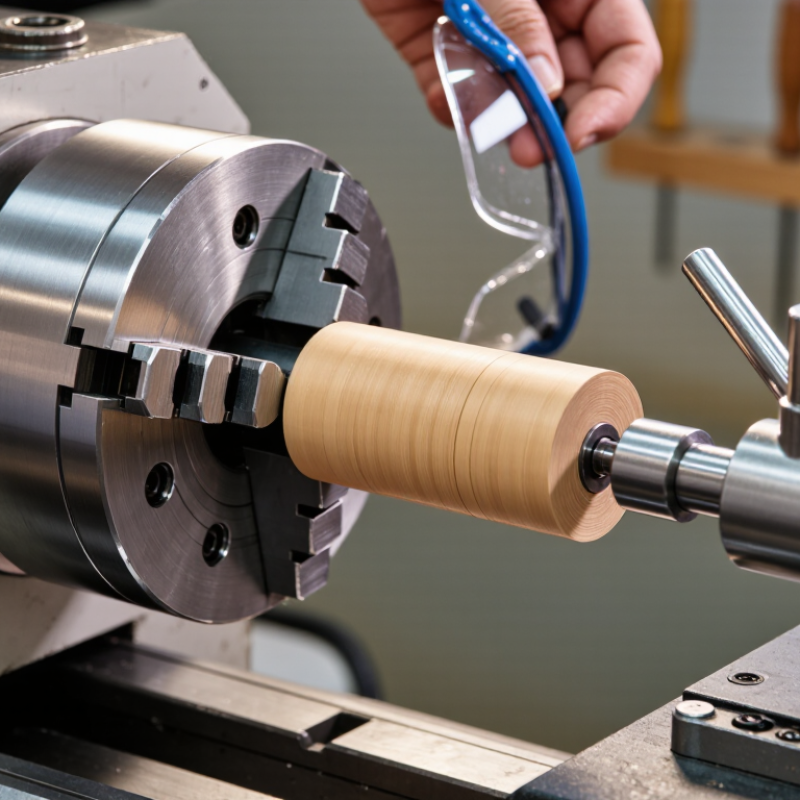
How to Find Maximum Speed for a 4 Jaw Woodworking Chuck?

Define the Chuck, Lathe, and Workpiece Limits

Finding maximum speed for a four-jaw woodworking chuck starts with three separate limits. The chuck has a rated speed, but that figure assumes proper jaws, balance, and mounting. Check the body, screws, jaw slides, and adapter for wear. A small crack, packed dust, or loose jaw can reduce safe capacity. I inspect the chuck before every demanding setup. This habit is simple, though I have occasionally rushed it. That mistake deserves respect.

The lathe sets another boundary. Read its manual for spindle speed, acceleration, and permitted chuck size. A powerful motor does not make an unbalanced blank safe. Begin at the lowest speed and watch for vibration while standing outside the rotation plane. Increase speed gradually, stopping when vibration, movement, or unusual noise appears. The lowest applicable rating controls. Never treat a speed controller’s highest setting as a safe target.

The workpiece often determines the practical limit. Measure its diameter, length, mass, moisture, and grain condition. A wide, heavy bowl blank creates greater centrifugal force than a small, dry spindle. Keep unsupported length short, seat the blank fully, and tighten opposing jaws evenly. Recheck the mounting after a brief run. For irregular blanks, reduce speed sharply and use a tailstock when appropriate. I sometimes calculate a generous theoretical RPM, then reject it after a visual check reveals imbalance. The calculation was not wrong; my judgment was incomplete. Use the lowest limit among chuck, lathe, and workpiece.

Gather the Key Specifications Before Calculating Speed

How to Find Maximum Speed for a 4 Jaw Woodworking Chuck?

Gather the Key Specifications Before Calculating Speed

Before calculating RPM, record the chuck’s rated maximum speed, jaw capacity, thread size, body diameter, and mounting method. Confirm the lathe’s spindle limit too. The lower value controls. The workpiece also matters. A 300 mm bowl creates far greater centrifugal force than a 100 mm blank at identical RPM. That force rises with the square of speed, so a small RPM increase can have a serious effect.

Use this basic relationship: surface speed equals π × diameter × RPM. Convert diameter to feet when comparing cutting data. However, this equation does not prove that a chuck is safe. Check the chuck manufacturer’s technical sheet for gripping limits, recommended jaw projection, and minimum contact length. The Health and Safety Executive’s Woodworking Information Sheet WIS6 stresses secure workholding, guarding, and following equipment instructions. U.S. OSHA regulation 29 CFR 1910.213 also requires suitable machine guarding for woodworking operations.

In practice, inspect the blank for cracks, knots, imbalance, and excessive overhang before testing speed. Start well below the rated limit, then increase gradually while standing outside the rotation plane. Stop if the chuck vibrates, jaws shift, or the timber sounds different. I would record the actual diameter, jaw setting, and RPM in a workshop log. My first calculation might look precise, but it can still ignore weak grain or poor jaw contact. That is the uncomfortable part. A published limit is not a target.

Calculate Maximum Speed from Chuck Diameter and Balance

How to Find Maximum Speed for a 4 Jaw Woodworking Chuck?

Maximum speed begins with diameter, but diameter alone cannot approve a speed. Use the surface-speed equation: N = 1000V ÷ πD. N is revolutions per minute, V is surface speed in meters per second, and D is chuck diameter in millimeters. For a 100 mm chuck at 10 m/s, the calculation gives about 1,910 rpm. This is only a starting estimate. HSE Woodworking Information Sheet WIS40 advises considering workpiece diameter, balance, mounting security, and projected mass when choosing lathe speed. Measure the actual chuck body, not just the visible jaw span. A small mistake matters.

Balance controls the practical limit. ISO 21940-11 defines balancing quality grades for rotating components; G2.5 is commonly used for precision-balanced parts, but it does not certify every chuck at every rpm. An eccentric jaw setting, uneven timber, or a long blank can create strong centrifugal force. If the chuck manufacturer lists a lower rated speed, use that value. Never exceed it. OSHA 1910.213 also requires effective guarding for woodworking machinery, although it does not provide a universal chuck-speed number. Begin well below the calculated limit, run the empty chuck briefly, and watch for vibration. Then test the mounted blank at a reduced speed. My calculation may look precise, yet wood density and jaw engagement remain uncertain. That uncertainty deserves a margin.

Adjust the Speed for Workpiece Size, Shape, and Mounting

A four-jaw woodworking chuck does not have one safe speed for every project. Adjust RPM to the workpiece diameter, shape, and mounting quality. A useful calculation is surface speed: RPM = cutting speed × 12 ÷ (π × diameter in inches) For example, a 4-inch blank at 1,000 RPM produces about 1,047 surface feet per minute. A 10-inch blank at the same speed produces far greater rim movement and demands more control. Size matters.

Shape matters more than many beginners expect. Round, balanced blanks usually tolerate higher speeds than square, bark-edged, or irregular pieces. Start slowly, then increase speed only after checking for vibration. The U.S. Occupational Safety and Health Administration requires effective guarding around woodworking machinery under 29 CFR 1910.213. HSE Woodworking Information Sheet WIS17 also stresses secure holding, suitable speed, and safe operator positioning. These are not decorative rules.

Mounting quality changes the risk again. Seat the jaws fully, tighten evenly, and keep the gripping area clean. For delicate tenons, reduce speed sharply. A large bowl blank may need 300–600 RPM during initial rounding, while a small balanced spindle may run near 1,500–2,000 RPM, if the chuck and lathe allow it. Treat these figures as working references, not promises. I sometimes reduce speed more than necessary. That costs time, but it exposes fewer surprises. Stop immediately if the chuck creeps, the blank shifts, or vibration increases.

Verify the Safe Speed with Manufacturer and Lathe Guidelines

How to Find Maximum Speed for a 4 Jaw Woodworking Chuck?

A four-jaw woodworking chuck has no universal maximum speed. The safe limit depends on chuck design, jaw type, workpiece diameter, balance, and mounting quality. A 4-inch blank spinning at 1,000 RPM produces about 1,047 surface feet per minute. A 6-inch blank reaches approximately 1,571 feet per minute at the same speed. That extra diameter adds serious rotational energy. Start low, around 300–500 RPM, and watch for vibration, movement, or unusual noise.

The chuck’s rating must never exceed the lathe’s published limit. Check both manuals, not just the chuck label. Manufacturer guidance should identify the maximum RPM for each jaw configuration and gripping method. HSE woodworking safety guidance and OSHA machine-safety requirements both emphasize guarding, secure workholding, and operator control. Their guidance does not replace the chuck maker’s tested rating. If the two limits differ, use the lower one. Never estimate from experience alone.

I once considered a balanced blank safe because it ran quietly at low speed. That judgment was incomplete. A small crack appeared after repositioning the jaws. Inspect the timber, threads, jaws, and backing plate before every session. Keep the tailstock engaged when practical, especially with long or uneven blanks. Increase speed gradually, standing outside the rotation plane during the first test. Imperfect balance matters. My safer practice is simple: calculate surface speed, verify both manuals, then reduce RPM whenever uncertainty remains.

How to Find Maximum Speed for a 4 Jaw Woodworking Chuck? - Verify the Safe Speed with Manufacturer and Lathe Guidelines
Data Dimension What to Check Practical Data or Calculation Safety Decision
Core Speed-Verification Rules
Controlling speed limit Compare every available limit before starting the lathe. The permitted operating speed is the lowest applicable value:

Safe RPM = minimum of chuck rating, lathe rating, workpiece limit, and setup limit
Never exceed the lowest verified limit.
Chuck manufacturer rating Read the chuck manual, product label, or technical specification for the exact chuck and jaw configuration. Record the stated maximum RPM, required jaw type, minimum gripping diameter, maximum overhang, and any restrictions for natural-edge or unbalanced work. Do not substitute a rating from a similar-looking chuck.
Lathe rating Check the lathe manual, speed selector, drive system, spindle, and adapter limitations. Use the lowest rated speed of the complete lathe assembly. A lathe with a high-speed setting does not automatically make every chuck or workpiece safe at that speed. The lathe maximum cannot override a lower chuck or workpiece rating.
Workpiece diameter Measure the largest rotating diameter, including protruding stock and irregular edges. Larger diameters create greater rim speed and centrifugal force. Measure the actual workpiece, not only the chuck body or nominal blank size. Reduce RPM as diameter, mass, imbalance, or overhang increases.
Workpiece balance Assess whether the blank is round, square, rectangular, natural-edge, hollow, cracked, or unevenly weighted. A balanced, sound, round blank is generally easier to run safely than an irregular or natural-edge blank of the same diameter and mass. Use a substantially lower speed for unbalanced, cracked, loose, or uncertain stock.
Jaw engagement Confirm that all four jaws contact the workpiece correctly and that the tightening method matches the chuck instructions. Use the specified dovetail, tenon, recess, or straight-sided grip. Maintain full, even jaw contact and avoid gripping only a narrow edge. Stop if the workpiece rocks, slips, or does not seat firmly against the register.
Overhang Measure the distance from the chuck jaws to the farthest cutting area. A longer overhang increases bending and vibration. Support long work with a suitable tailstock, steady rest, or other approved support when practical. Lower the speed when overhang or vibration increases.
Reference Calculations for Rotating Diameter
Surface-speed formula Convert diameter and RPM into approximate rim speed. Surface speed (ft/min) = π × diameter (in) × RPM ÷ 12

Surface speed (m/min) = π × diameter (mm) × RPM ÷ 1,000
Use this calculation for comparison only; it does not replace the chuck or lathe rating.
4-inch diameter at 500 RPM Illustrative rim-speed calculation π × 4 × 500 ÷ 12 = approximately 524 ft/min
π × 101.6 × 500 ÷ 1,000 = approximately 160 m/min
Acceptable only if the complete setup is rated for at least 500 RPM.
4-inch diameter at 1,000 RPM Illustrative rim-speed calculation π × 4 × 1,000 ÷ 12 = approximately 1,047 ft/min
π × 101.6 × 1,000 ÷ 1,000 = approximately 319 m/min
Do not use this speed merely because the blank is 4 inches; verify all equipment limits first.
6-inch diameter at 800 RPM Illustrative rim-speed calculation π × 6 × 800 ÷ 12 = approximately 1,257 ft/min
π × 152.4 × 800 ÷ 1,000 = approximately 383 m/min
A larger diameter produces higher rim speed at the same RPM, so a lower RPM may be appropriate.
Reverse calculation Estimate RPM from a selected rim speed. RPM = surface speed (ft/min) × 12 ÷ [π × diameter (in)]

Example: 800 ft/min for a 4-inch diameter:
800 × 12 ÷ (π × 4) = approximately 764 RPM
The result is only a calculation starting point and must be reduced if any component has a lower rating.
Pre-Start and Operating Checks
Before mounting Inspect the chuck, jaws, threads, insert, screws, key, and workpiece. Reject cracked, damaged, excessively worn, loose, or contaminated components. Remove bark, stones, metal fragments, and other embedded hazards from the mounting area. Do not operate a damaged chuck or questionable workpiece.
After tightening Verify seating and clearance by rotating the workpiece by hand with the lathe switched off. Confirm that the work clears the tool rest, bed, guards, tailstock, and other equipment through a complete manual rotation. Correct contact, clearance, and alignment problems before applying power.
Initial startup Stand outside the potential line of fire and start at the lowest practical speed. Observe for wobble, movement, unusual noise, vibration, or loosening. Increase speed gradually only when the assembly remains stable. Stop immediately if movement, vibration, or sound changes unexpectedly.
During turning Use eye and face protection and keep clothing, hair, hands, and tools clear of the rotating assembly. Maintain a stable tool-rest position and use appropriate cutting technique. Recheck the workpiece after interruptions or significant material removal. Never reach over or around a rotating chuck.
Final verification record Document the selected RPM and the limits used to select it. Record: chuck model or specification reference, stated chuck maximum RPM, lathe maximum RPM, workpiece diameter, balance condition, jaw configuration, overhang, and selected operating RPM. Use the documented value only when every listed condition remains unchanged.
Important limitation Understand the difference between a calculated speed and a certified safe speed. Diameter-based calculations describe rim speed only. They do not account for chuck design, jaw geometry, gripping force, material defects, imbalance, centrifugal loading, spindle condition, or operator position. Manufacturer and lathe instructions always take priority over general calculations.

FAQS

What determines the maximum speed of a four-jaw woodworking chuck?

Use the lowest limit from the chuck, lathe, and workpiece. Start low. The chuck rating alone is not enough.

How should I check the chuck before use?

Inspect the body, screws, jaw slides, threads, and adapter. Look for cracks, packed dust, loose jaws, or worn parts. A clean appearance can still mislead.

What speed should I use for the first test?

Begin around 300–500 RPM when conditions allow. Stand outside the rotation plane. Increase speed gradually, not suddenly.

Why does blank diameter affect safe speed?

Larger blanks create more surface speed and rotational energy. A six-inch blank moves faster at its edge than a four-inch blank. That difference matters.

How can I recognize an unsafe setup?

Stop if vibration, movement, or unusual noise appears. Watch the blank during a brief low-speed run. Do not continue because the sound seems minor.

What workpiece details should I inspect?

Check diameter, length, weight, moisture, grain, cracks, and balance. Keep unsupported length short. A wide, heavy bowl blank needs extra caution.

How can I improve the mounting?

Seat the blank fully and tighten opposing jaws evenly. Recheck the mounting after a short test. Use a tailstock when practical, especially with long or uneven blanks.

Can a theoretical RPM calculation prove the setup is safe?

No. A calculation only estimates part of the risk. I once trusted a quiet blank too quickly. Later, a small crack appeared after repositioning. My calculation was not wrong. My judgment was incomplete.

Conclusion

Determining what is the maximum speed for a 4 jaw woodworking chuck requires more than looking at the chuck diameter alone. First, identify the separate limits of the chuck, lathe, and workpiece, since the safest operating speed is controlled by the lowest-rated component. Collect key specifications such as chuck size, maximum recommended RPM, jaw capacity, workpiece weight, and the lathe’s available speed range. A larger chuck generally creates greater rotational force, while an unbalanced chuck or blank may require a substantial speed reduction.

Next, consider the workpiece’s diameter, shape, density, and mounting method. Large, irregular, heavy, or weakly secured pieces should be turned slowly until they are balanced and firmly supported. Use the chuck’s published guidance and the lathe manufacturer’s instructions to confirm the final setting. Begin at a low speed, observe the workpiece for vibration or movement, and increase speed gradually only when everything remains stable. Proper tightening, clearance, and protective equipment are also essential for safe operation.

Isabella

Isabella

Isabella is a dedicated marketing professional with a sharp focus on driving brand growth and engagement through strategic content creation. With an extensive background in digital marketing, she combines her passion for storytelling with her keen understanding of industry trends to deliver......